Read your life
Read your own life through the four capitals and the lifestage lens — accumulation, pivot, drawdown.

Longevity Literacy 2.0 — a private masterclass and one-to-one advisory for people who intend to be wealthy in every year of a long life.
Only 24% of adults were longevity literate
Scroll24%
of adults were longevity literate.
In a six-country Allianz study, only 24% of adults were longevity literate — able to answer basic questions about how long life actually lasts.
Figure 0 — 24 in every 100
9.6 years
The average healthspan gap between living and living in good health.
183
Countries across which that gap is now measured.
Every
health event is also a wealth event. Almost no one is taught to see both at once.
Life expectancy is a distribution, not a number. Plan to the average and you have roughly even odds of outliving your plan.
Accumulation, pivot, drawdown — and the shock moments that compress cross-capital decisions into weeks.
Accumulation
Pivot
Drawdown
A short, private reflection. No score, no assessment, no diagnosis — only four questions about how you currently plan for a long life.
Longevity Literacy 2.0 is the ability to reason about an uncertain — and probably longer than expected — life. It rests on four forms of capital: your financial capital, your health capital, your social capital, and the structural capital of the systems around you — pensions, care access, tax, succession.
Financial advice looks at one capital. Health advice looks at another. Longevity Literacy 2.0 is the discipline of seeing all four move together — early, while the leverage is still yours.
Swipe, drag or tap a card
What no one else teaches is how they move. The four capitals shift with age and with shocks — a diagnosis, a caregiving call, a succession. And they convert into one another: money buys health, family care substitutes for money at the cost of income, structure protects wealth across transitions.
They do not sit still
Figure 1 — Longevity Literacy 2.0
Traditional longevity literacy is about retirement: pension maths, life expectancy at 65. Useful — and two decades too late.
Traditional longevity literacy
Longevity Literacy 2.0

What is unbridgeable at 60 is inexpensive at 35. That is why this work belongs now, not at retirement.
Longevity Literacy 2.0 relocates the question to the whole of life. It bridges what financial literacy and health literacy each miss: how money and health move together over time. It is a formalised, original framework — not a repackaged retirement seminar — developed through advisory work with private clients and financial institutions, and set out in an academic manuscript.
What you will understand afterwards.
Read your own life through the four capitals and the lifestage lens — accumulation, pivot, drawdown.
Anticipate the shock moments — diagnosis, caregiving, succession, loss — where cross-capital decisions compress into weeks.
Understand the conversion decisions you are already making without naming them — and the ones ahead.
Physical Health
Poor health erodes earning capacity — the dimension the other four are lived through.
Figure 2 — Wellthspan Advisory 5+1 Framework
Longevity Literacy 2.0 teaches you to reason about how money and health move together. Inside the masterclass, that reasoning is applied to the whole of your life through the Wellthspan Advisory 5+1 Framework — Nadine’s model of what a longer life has to keep in balance.
Five interconnected dimensions: your physical health, your mental health, your social health, your purpose, and your financial health. They are one ecosystem, not five silos — poor health erodes earning capacity, financial insecurity restricts prevention, strong relationships carry you through disruption, and a loss of purpose reaches into all the rest.
The +1 is time. Not a sixth pillar — the constraint and multiplier across all five.
Everyone has the same 24 hours; decisions compound across decades; and early action buys options that late action cannot. In the masterclass you will assess your own resilience across all five dimensions — and see where time is still working for you.
KNOWING
Understanding how a long life actually behaves — the four capitals, the lifestages, the shocks.
DOING
The framework applied, privately, to one life: yours.

Wealthspan Planning — Pillar 01 of de-risking longevity
For those who want the framework applied, privately, to their own life: a one-to-one engagement mapping your four capitals, your lifestage, your exposures, and the conversions that will define the decades ahead.
Wealthspan Planning is Pillar 01 of de-risking longevity — a plan for the whole of a longer life, not only the money in it. Engagements are confidential and taken by application only.
Not investment advice.
Not medical advice.
Not a promise.
This is not investment advice, and nothing is sold beyond the work itself. It is not medical advice. And it is not a promise: literacy is necessary, not sufficient — outcomes also depend on systems, circumstance, and health. What this work does is put the understanding, and the timing, on your side.
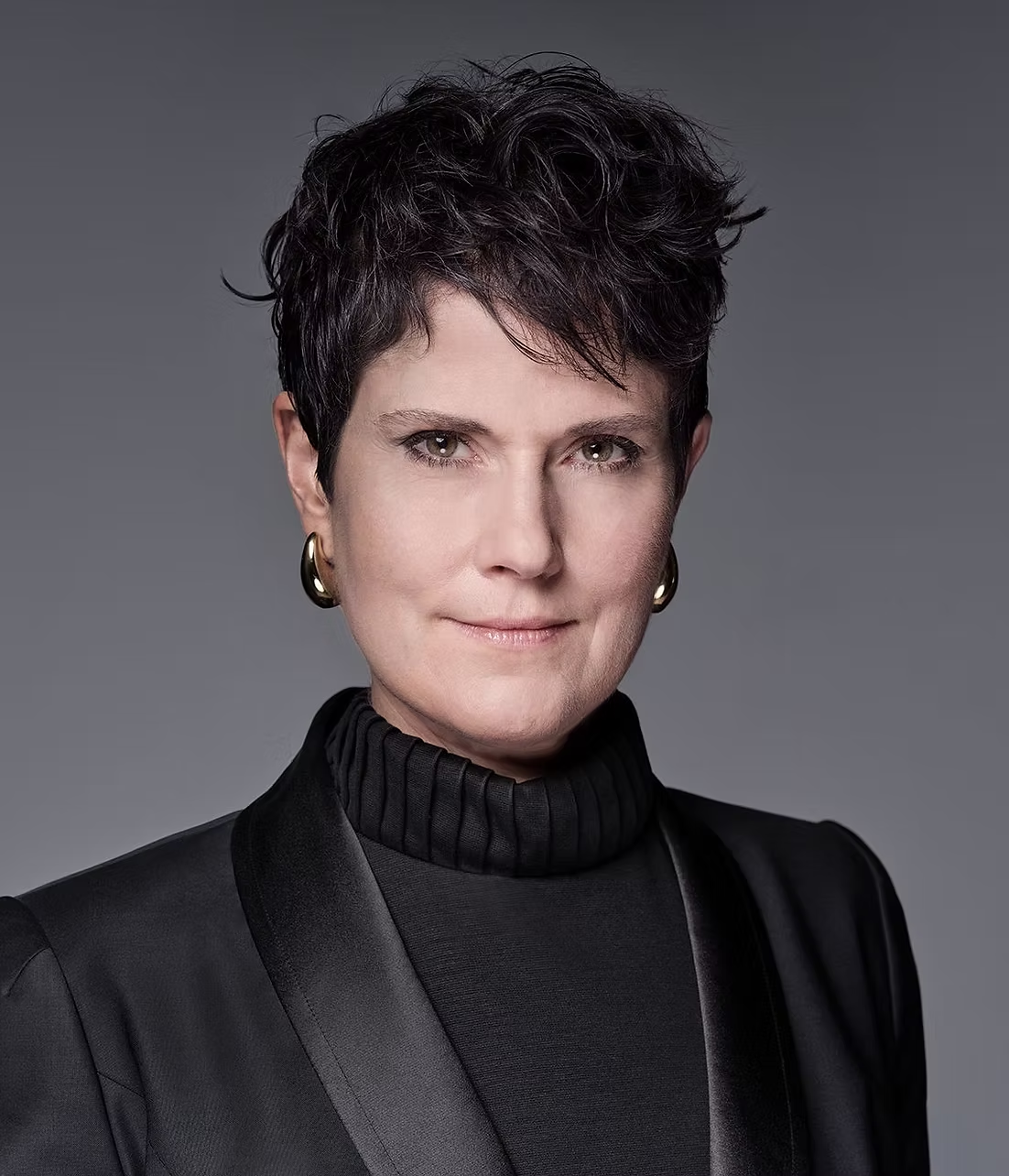
Nadine Esposito is the founder of Wellthspan Advisory (Switzerland & Australia) and the creator of two original frameworks: Longevity Literacy 2.0 — a model of how financial, health, social, and structural capital move across a long and uncertain life, formalised in an academic manuscript — and the Wellthspan Advisory 5+1 Framework.
She advises financial institutions — banks, insurers, wealth managers — on longevity as a strategic risk, and speaks internationally on the economics of longer lives. [Prior career / years of experience / credentials — TO CONFIRM.]
Working with Nadine means working with the person who built the framework, not a practitioner certified in someone else’s. Private clients get the same institutional-grade thinking she brings to boardrooms — applied to one life: theirs.
Her independence is structural: she sells no products, earns no commissions, and represents no institution.
[Confidentiality note — TO CONFIRM: one-line statement to Swiss data-protection (revFADP) standard.]